Policy and Basic Approach
Sustainability Policy
The Daiwa House Group’s basic approach is “Creating Dreams, Building Hearts.” As a group that co-creates value for individuals, communities and people’s lifestyles, the Daiwa House Group aims to build trusting relationships with stakeholders and contribute to society through its businesses, and to realize a sustainable society by meeting the challenge of achieving “zero environmental impacts.” Daiwa House Asset Management Co., Ltd. shares the Daiwa House Group’s basic approach as DHR’s asset manager, and considers that including consideration for ESG in its real estate investment management operations contributes to DHR’s basic policy of ensuring stable revenue and steady growth of assets over the medium to long term. Therefore, we have established the following “Sustainability Policy” to guide our real estate investment management.
-
1. Prevention of global warming
We will promote energy conservation measures through the installation of energy conservation equipment and so forth to realize a carbon-free society. We will also consider introduction of renewable energy power generation facilities and acquisition of properties that have such equipment installed.
-
2. Harmony with the natural environment (preservation of biodiversity)
We will aim for a society that is able to pass on abundant natural resources to future generations in order to protect and improve natural capital. We will also promote planting and management considering harmony with the surrounding environment.
-
3. Conservation of natural resources (protecting water resources, reducing waste)
We will work towards the realization of a recycling-oriented society by promoting water conservation measures through the installation of water conservation equipment. We will also promote 3R activities (reduce, reuse, and recycle) for resources.
-
4. Prevention of chemical pollution
We will aim to realize a society where people and ecosystems do not suffer adverse effects from chemical substances by promoting reduction, substitution and appropriate management of harmful chemical substances when managing real estate, and taking efforts to minimize risks.
-
5. Establishment of an internal framework and initiatives for employees
We will establish an internal framework for promoting sustainability and take steps to develop human resources by conducting regular education and training for employees. We will also aim to create workplaces where people can work safely and healthily, and workplaces where diverse employees can work flexibly. (Note 1)
-
6. Building of trusting relationships with external stakeholders
We will aim to build trusting relationships with external stakeholders and we will work on our suppliers to enhance the satisfaction of tenant customers and promote CSR in our supply chain. We will undertake neighborhood co-existence activities with local residents. (Note 2)
-
7. Promotion of communication through information disclosure
We will proactively disclose ESG-related information and utilize dialogues with stakeholders, such as investors, in our future business activities. Furthermore, we will aim for continuous acquisition of Green Building Certification. (Note 2)
-
8. Compliance with laws and regulations, and risk management
We will comply with ESG-related laws and regulations. Moreover, we will strive to implement appropriate risk management, such as giving consideration for the environmental and social impacts in risk evaluations when acquiring real estate and promoting awareness of human rights.
- Sustainability training is provided in order for employees to understand the impact of their business activities on the environment.
- Training and engagements are conducted to raise the awareness of internal and external stakeholders on environmental management policies and environmental impacts.
Items to Confirm When Considering a Property Acquisition
The Asset Manager confirms the following items when considering a property acquisition.
| Item | Confirmation details |
|---|---|
| Disaster risk |
|
| Environmental certifications |
|
| Energy data |
|
| Green lease agreements |
|
| Compliance with environmental laws and regulations |
|
| Disaster preparedness agreements |
|
Compliance with Environmental Laws and Regulations
Based on reports from property management (PM) companies and building management (BM) companies regarding environmental laws and regulations pertaining to DHR’s business activities, DHR has confirmed that there are no omissions of reporting or violations of laws and regulations.
There were no guidance matters or lawsuits from the relevant authorities regarding violations, etc. (FY2025)
Sustainable Procurement Policy
The Sustainable Procurement Policy is one of the policies to put into practice the individual items set forth in the Asset Manager’s Sustainability Policy and sets forth guidelines pertaining to the selection criteria of products, etc., to be procured for the management of DHR’s real estate portfolio, as well as the selection and evaluation criteria of suppliers. The Asset Manager will aim to include, to the extent possible, the Sustainable Procurement Policy in its decisions on the selection and evaluation of products and suppliers to be procured.
Sustainable Procurement Policy (Product Selection Criteria)
What the Sustainable Procurement Policy Stipulates (Excerpts)
Environmental Conservation
Aiming to realize a society in which people can live comfortably and in harmony with the environment, and striving to reduce the environmental impact of our business processes, products, and services.
- Compliance with environmental laws and regulations and response to social demands
- Challenge towards carbon neutrality
- Challenge towards a circular economy
- Management of chemical substances
- Considerations for biodiversity
- Response to water risks
Co-creation and Symbiosis with Local Communities
Respecting the cultures and customs of the regions in which we operate and striving to contribute to the sustainable development of local communities through our business activities, etc.
- Considerations and contributions to the local residents and communities in which we operate
Chemical Substance Management
Not using substances, etc., that are prohibited by domestic law.
Respect for Human Rights
Respecting the dignity and fundamental human rights of all persons involved in our business activities and refraining from human rights violations or discrimination.
- Prohibition of discrimination
- Prohibition of forced labor
- Prohibition of child labor
- Prohibition of harassment
- Respect for the rights of indigenous people
- Freedom of association and the right to collective bargaining
- Payment of fair wages
- Working hours
- Responsible procurement
- Access to relief
- Protection of identity and elimination of retaliation
- Respect for the human rights of foreign workers
Biodiversity
In procuring wood, striving to use timber that has been verified as legal and sustainable, or procure 100% recycled timber.
Sustainability Promotion System
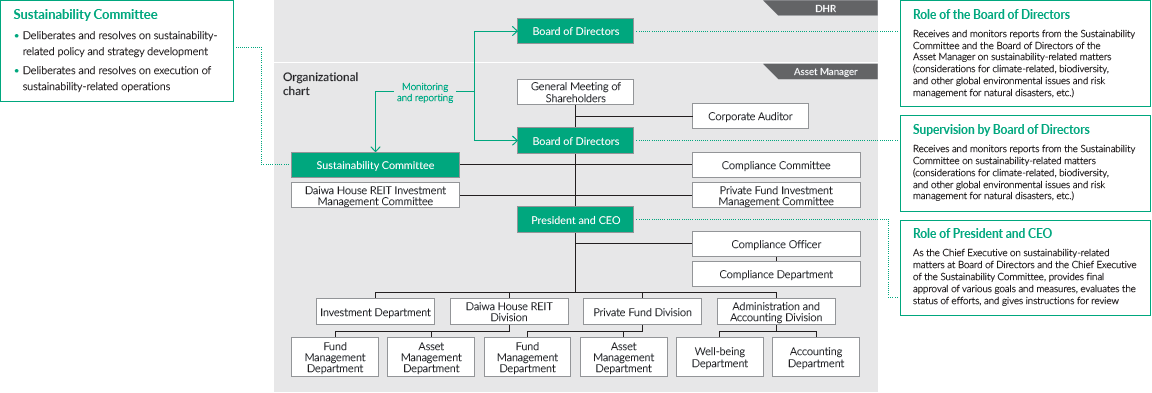
To promote awareness of ESG based on the Sustainability Policy, the Asset Manager is working to secure an appropriate system for promoting sustainability. To do this, it established the “Regulations Concerning the System for Promoting Sustainability” and rules regarding topics such as internal framework, collaboration with stakeholders, and information disclosure policy. In addition, a meeting of the Sustainability Committee must be held at least once a month, in principle, to examine goals and measures related to sustainability. The Asset Manager is working to achieve these goals and implement various measures. Moreover, in principle, the Head of the Sustainability Committee annually directs the Committee to assess the status of all sustainability initiatives and to review them as necessary.
Organizational Chart
| Committee Head | President and CEO |
|---|---|
| Operating officer | General Manager of Well-being Department, Administration and Accounting Division |
| Executing officer | Head of Daiwa House REIT Division, Head of Private Fund Division |
Sustainability Committee
| Members | All full-time Directors, Heads of Division, General Managers (excluding General Manager of Compliance Department and the General Manager of Internal Audit Department), and other selected officers and employees |
|---|---|
| Observers | Outside expert advisor, Compliance Officer, General Manager of Compliance Department and General Manager of Internal Audit Department |
| Frequency of meetings | At least once a month |
| Function and role | Deliberations and approvals regarding sustainability-related policy and strategy development and execution of sustainability-related operations, and reporting to the Board of Directors and the DHR Board of Directors as appropriate |
Number of Sustainability Committee Meetings Held
| Fiscal year ended March 2023 | Fiscal year ended March 2024 | Fiscal year ended March 2025 | Fiscal year ended March 2026 |
|---|---|---|---|
| 12 | 12 | 12 | 12 |
Number of Reports on Sustainability-related Matters
| Asset Manager Board of Directors | DHR Board of Directors | |
|---|---|---|
| Number of reports on sustainability-related matters (Fiscal Year Ended March 2026) |
12 | 12 |
Main Items Reported and Resolved (Fiscal Year Ended March 2026)
Sustainability Committee
Resolutions
Order of succession for the Acting Chair of the Sustainability Committee; selection of projects for the issuance of Sustainability Bonds; conclusion of Green Loans agreements; withdrawal from initiatives
Reports
Sustainability-related budget planning; sustainability assessment (outside expert advisor); sustainability implementation plan and results; annual sustainability-related work schedule; preparation and disclosure of the sustainability report; dedicated ESG website updates; submission of GRESB response and receipt of rating results; submission of CDP Climate Change Program response and receipt of rating results; submission of S&P Global Corporate Sustainability Assessment (CSA) response and receipt of assessment results, and selection as Sustainability Yearbook Member; submission of PRI Annual Report and receipt of assessment; application to ESG Finance Awards Japan by Japan’s Ministry of the Environment and selection as an Environmentally Sustainable Company; recognition as a 2026 Outstanding Organization of KENKO Investment for Health (SME Category); sustainability training (workshops) survey results; and report on interview with GRESB
Asset Manager Board of Directors and DHR Board of Directors
Resolutions
Conclusion of Green Loans agreements; sustainability index-linked fees
Monthly Reports
Management of sustainability-related budget and performance, climate change-related issues, external evaluation-related matters, environmental certifications for portfolio properties, participation status in initiatives, and sustainability-related contracts
Individual Reports
Annual sustainability-related work schedule; issue of the sustainability report; dedicated ESG website updates; GRESB 2025; CDP 2025; S&P CSA Rating; PRI Annual Report; ESG Finance Awards Japan; 2026 Outstanding Organizations of KENKO Investment for Health; status of environmental performance; status of green lease agreements; outside expert-led sustainability training (workshops); engagement in workers’ rights; questions from investors regarding ESG-related initiatives in investor relations
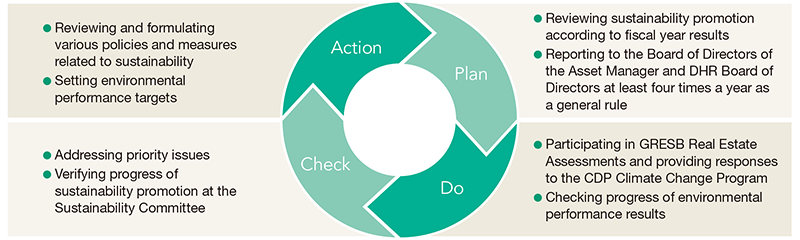
Concept of Sustainability Promotion Based on the PDCA Cycle